Ukraine's Drone Playbook: Cheap, Clever, and Relentless
Kyiv has built a war-winning industry from plywood, code and crowdsourcing. Russia is learning that it is cheaper to improvise than to intercept.
Ukraine’s most innovative factory rarely shows up on satellite images. It is not a single plant but a lattice of garages, makerspaces and small workshops, stitched together by Telegram chats and delivery vans. From this distributed network come two families of weapons that have bent the battlefield: long-range one-way attack aircraft and small first-person-view (FPV) quadcopters; and, at sea, a growing menagerie of unmanned surface vessels able to menace warships and bridges alike. With Western arsenals tight and front-line ammunition rationed, Ukraine has made drones the signature technology of its war of attrition—and increasingly, its means of imposing costs deep inside Russia.
The results are visible on two maps: the Black Sea and Russia’s refinery belt. In the Black Sea, naval drones have helped push much of Russia’s fleet eastward, blunting the blockade and opening export lanes. On land, long-range strikes have ignited refineries hundreds of kilometres from the border, shrinking Russia’s fuel cushion and spooking insurers. Each successful raid advertises a lesson: mass, modularity and software eat legacy platforms for breakfast.
Deep strikes, shallow costs
Through the autumn of 2025 Ukraine has intensified its long-range drone campaign against oil and logistics infrastructure across Russia. Overnight swarms have reached as far as Bashkortostan and the Volga region; in November, a strike on Voronezh temporarily cut utilities, underscoring how the campaign can impose civilian-facing disruptions without expending cruise missiles. Western market data align with the battlefield footage: the tempo of attacks has curtailed refining capacity and pinched diesel exports, a lucrative line of business for Moscow. The economics are lopsided. A plywood-and-foam airframe with automotive components, steered by commodity flight computers and increasingly aided by vision-based guidance, can cost tens of thousands of dollars. The interceptors sent to stop it, and the repairs needed if it slips through, cost many multiples of that.
Signature platforms in this long-range tier include the homegrown AQ-400 “Scythe,” a one-way attack drone designed for mass production. Its makers tout range, modular payloads and rapid assembly—attributes that suit a dispersed manufacturing model and allow Ukraine to scale capacity without a single vulnerable factory. The goal, plainly, is saturation: force Russian air defences to waste expensive interceptors, and where gaps appear, punish high-value energy targets. Earlier in the year, strikes on major refineries like Ryazan illustrated the concept: even temporary outages can ripple through prices and supply chains.
The garage air force
A tier down from the long-range weapons, FPV drones have transformed tactics along the line of contact. 2025 has seen millions of small quadcopters hurled into the fight by both sides, with Ukraine honing a craft-industrial edge: 3D-printed mounts, quick-swap munitions, and ad-hoc anti-jamming tweaks that cycle from idea to fielding in weeks, not quarters. Units now think in terms of “drone artillery”—companies measure fires not by 152mm shells but by daily sortie allotments of FPVs, loiterers and reconnaissance birds. RUSI, a defence think-tank, summarises the trend bluntly: modern land warfare is now overwhelmingly characterised by mass FPV use supplemented by thousands of one-way attack (OWA) drones. To absorb the blows, both sides mount cage armour, deploy motorcycle units to dart between tree lines and push portable electronic-warfare (EW) kits forward. The result is a Darwinian ecosystem: frequencies hop, antennas sprout, and counter-counters follow on their heels.
Ukraine’s answer to intensifying Russian jamming has been twofold. First, redundancy in communications—multiple links and paths, from analogue video to digital mesh. Second, a gradual shift toward guidance less dependent on GPS and long-haul radio: terrain-referenced navigation, optical flow, even crude onboard models that recognise a target class well enough to ride the last seconds without a live operator. None of this is science fiction; it is what a nation does when necessity forces the software forward faster than peacetime procurement ever would. Open-source codebases and the diaspora talent pool do the rest.
The sea, remade by software
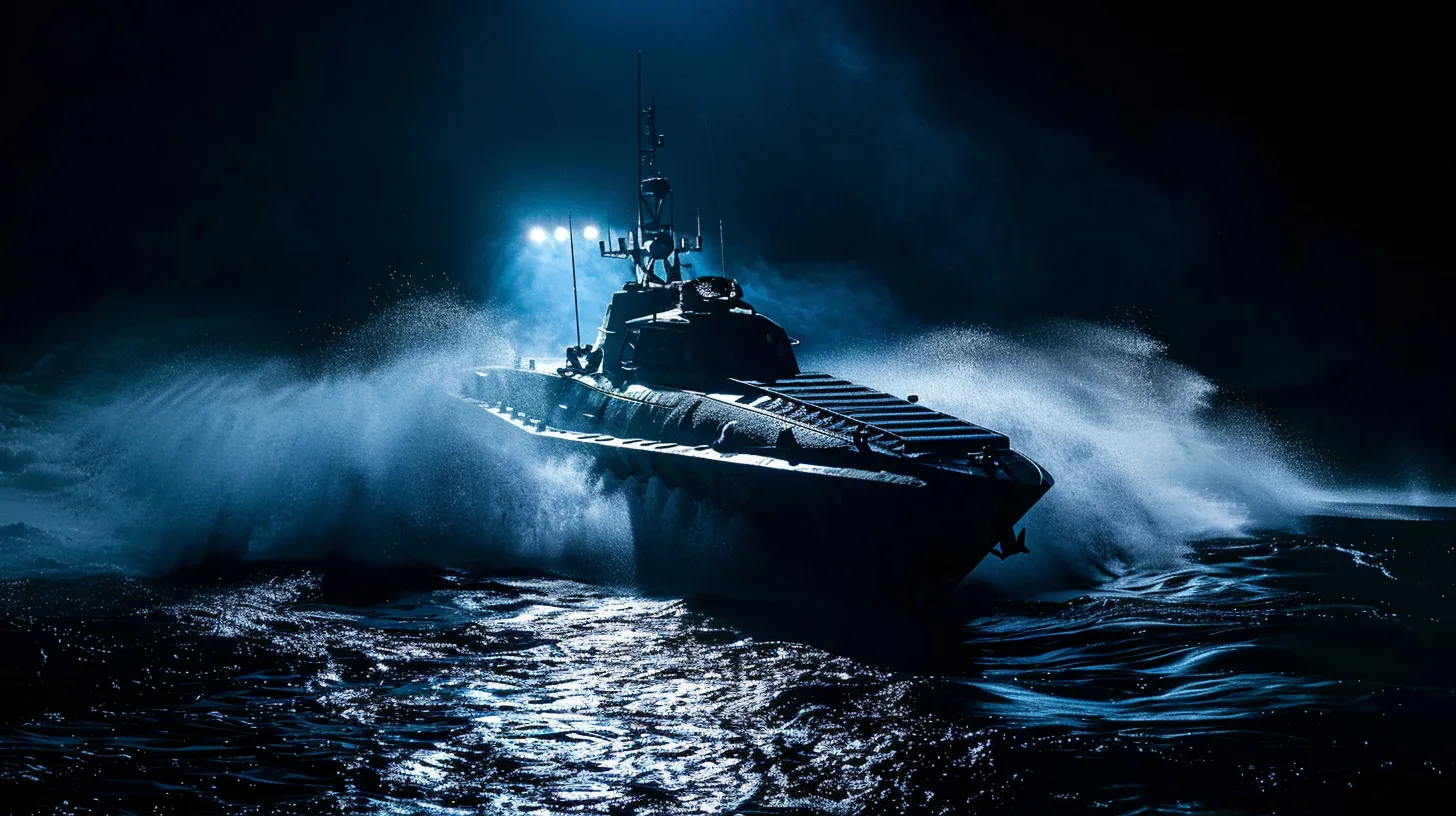
If the skies showcase scale, the water reveals creativity. Ukraine’s “Sea Baby” family—unmanned surface vessels (USVs) developed by the SBU security service—has steadily grown more capable. The latest iteration couples extended range (reported up to 1,500km) with modular weapon options, including a remote weapon station and even a compact rack of 122mm rockets. More striking than any single specification is how these boats are used: in multi-axis attacks, with reconnaissance and strike variants mixing at speed, at night, under EW pressure. The effect has been to force Russia into a defensive crouch. Key combatants and auxiliaries shifted east to Novorossiysk after repeated hits and near-misses around Crimea; the Kerch bridge has endured both blasts and months of nervous convoying.
A parallel line, the Magura series, has matured from explosive skiff to a family of USVs with improved navigation and, reportedly, options for more exotic payloads. Ukrainian sources credit these craft with damaging multiple vessels since 2023 and with imposing a psychological tax: crews who fear the surface are crews who sail less, or hug harbour more. The strategic dividend is trade. Each sailing of grain or steel is a small assertion that the blockade can be contested not just by frigates and maritime patrol aircraft but by software, cameras and composite hulls bouncing across the chop at 40 knots.
Russia adapts—and so does Ukraine
Moscow has not been idle. Its EW nets have thickened; its air-defence operators are battle-hardened; and its forces have fielded “mothership” UAVs that launch smaller drones from altitude, a gambit to extend reach and complicate interception. The front’s lower tiers now bristle with jammer masts and sensor posts, and the skies over depots glow with tracer from ZU-23s repurposed as drone-catchers. Even so, the architecture of Ukraine’s drone enterprise—dispersed production, rapid iteration, and a ravenous appetite for telemetry—remains harder to bomb than a factory and faster to evolve than a state procurement plan. Every Russian adaptation becomes new data.
Ukraine’s own air-defence picture has also changed. Officials tout improvements in intercept rates against Shahed-type loiterers and cruise missiles, while reserving scarce Patriot and SAMP/T interceptors for aircraft and ballistic threats. Here too, drones play on defence: cheap FPVs hunt down Russian reconnaissance birds and attack helicopters that stray too close; counter-FPV teams stalk launch crews. Red teams continuously probe Ukraine’s grid of passive sensors, looking for blind spots. The result is a messy, living system: a network as much cultural (habits, drills, debriefs) as technical.
The industrial base you can’t see
What sets Ukraine’s drone effort apart is not a single “wonder weapon” but an industrial logic designed for war under bombardment. Modular airframes made from civilian materials are easier to hide and replenish; supply chains that rely on global hobbyist markets are hard to throttle completely; and dispersed R&D cells survive even when particular sites are struck. Crowdfunding pays real dividends—both money and morale—while Western partners quietly help with components that have no obvious military profile. The doctrine emerging from this model is sophisticated: strike the far-rear energy system to sap revenue and logistics; attrit front-line units with FPV swarms; isolate the maritime theatre with USVs; and keep all of it cheap enough to be sustained even when aid is late or limited.
The economic pressure is not trivial. Analysts estimate that refinery outages and the cost of defending vast airspace have tightened Russia’s diesel balance and raised premiums. For a petrostate financing a long war, that matters. It also forces choices: keep S-300 batteries near Moscow and refineries, or push them to the front? Add more EW to protect bases, or reinforce units bracing for Ukrainian counter-raids? Each drone that makes it through is a reminder that perfect coverage is impossible over a continent-sized target set.
AI in the loop, but not the way you think
“AI-powered” is an overused label in defence brochures. On Ukraine’s front, the more honest description is “software everywhere.” Yes, there are experiments with machine-vision tracking and terminal guidance robust to jamming. But the less glamorous uses—automated route-planning that accounts for wind and radar horizons; batch mission-generation for swarms; debrief tools that ingest terabytes of POV video and EW logs to tune tactics—are where AI earns its keep. The man-in-the-loop remains central for ethical and practical reasons, especially in complex urban strikes. The point is not replacing the operator; it is amplifying the unit. Cheap autonomy manages the boring bits so humans can focus on judgement.
This “AI-lite” philosophy also speeds learning. Ukrainian formations share annotated footage, telemetry and after-action notes across units, compressing the cycle from field discovery to doctrine. When a new Russian jammer signature appears, frequency plans and antenna placements evolve within days. When a USV team discovers a harbour approach with dead ground under radar coverage, that path is codified and shared. The playbook is never finished because the code is never frozen.
What this means for 2026
For Western planners, Ukraine’s drone war is both a relief and a warning. Relief, because it shows how a smaller state can complicate a larger adversary’s campaign with asymmetric pressure at bearable cost. Warning, because the same playbook will be available to others—and to adversaries—soon enough. Stockpiles of exquisite munitions are poor substitutes for an agile industrial base and software-first doctrine. Air defence must be re-imagined as an economic system, not merely a technical one: if the attacker can build and launch at $20,000 a shot and the defender must answer at $200,000, the ledger decides the outcome eventually.
For Ukraine, the course seems set. Expect more long-range strikes on energy nodes, more USV forays across the Black Sea, and a steady chipping away at front-line positions with FPVs by the thousand. Expect, too, that Russia will keep adapting: more layered EW, more decoys, more hardening of critical plants. The arms race will remain dynamic. The side that iterates faster—organisationally as much as technologically—will have the better of it.
A new doctrine, hiding in plain sight
In peacetime, the idea of a national drone industry conjures visions of clean rooms and glossy brochures. Ukraine’s reality is humbler and more potent: benches scarred by soldering irons; crates of motors and props; teenagers who can tune a PID loop in their sleep; seasoned officers who know when to hand-fly the last 50 metres rather than trust a link. Add a maritime arm that slings rockets from remote turrets on fast, disposable hulls, and a long-range wing that can hit an oil hydrotreater 700km away, and you have a force that maps neatly onto a strategic need: impose costs, everywhere, all the time.
Wars are often remembered for the kit they made famous: Spitfires over the Channel; Stingers in the Hindu Kush. This one may be remembered for the moment when drones stopped being accessories and became the grammar of combat. That grammar is terse and unforgiving. Find the weak spot; write software to reach it; produce at scale; accept losses; learn; repeat. On land and sea, Ukraine has made that cadence its own—and taught the world how much damage can be done with plywood, lithium and code.